Modules
flair is a wrapper script with modules for running various
processing scripts located in bin directory and should be install in your path by pip or conda.
Modules must be run in order (align, correct, collapse).
- If you want to compare multiple samples, there are two primary ways of doing this:
Combine the fastq or fasta reads of all samples and run FLAIR align, correct, and collapse (or FLAIR transcriptome) on all samples together (will generate the most comprehensive transcriptome)
Run FLAIR align, correct, and collapse (or FLAIR transcriptome) on each sample separately (better for large sets of samples)
Use FLAIR combine to merge results
flair transcriptome
usage: usage: flair transcriptome -b reads.genomealigned.bam [options]
This module generates a transcriptome of high confidence isoforms (bed, gtf, and fasta files) directly from a bam file of aligned reads. This is 3x faster and uses 20x less memory than correct + collapse. To get aligned reads, you can use FLAIR align or just run the following command to generate the bam file to use as input. minimap2 -ax splice -s 80 -G 200k -t 20 –secondary=no genome.fa sample.fastq | samtools view -hb - | samtools sort - > sample.genomealigned.bam; samtools index sample.genomealigned.bam If you want to run downstream fusion detection with FLAIR fusion, run flair align with –filtertype separate to generate a separate file of chimeric alignments This module does not currently have all of the options included in collapse, such as promoter/3’ end filtering. Other options have been simplified or combined. For instance, the collapse –annotation_reliant option from flair collapse is now the default. To run without relying on annotation as strongly, specify –noaligntoannot
Outputs
flair.isoforms.bed
flair.isoforms.gtf
flair.isoforms.fa
flair.read.map.txt
Options
Required arguments
-b --genomealignedbam    Sorted and indexed bam file aligned to the genome
-g --genome    Reference genome in fasta format
Optional arguments
-o --output
                       output file name base for FLAIR isoforms (default: flair.collapse)
 -t --threads
                       minimap2 number of threads (4)
 -f --gtf              [HIGHLY RECOMMENDED] GTF annotation file, used for renaming FLAIR isoforms
                       to annotated isoforms and adjusting TSS/TESs
 -j --shortread
                       [HIGHLY RECOMMENDED] bed format splice junctions from short-read sequencing.
                       NO NOVEL SPLICE SITES WILL BE DETECTED WITHOUT ORTHOGONAL SHORT READS
 --ss_window
                       window size for correcting splice sites (15)
 -s  --support
                       minimum number of supporting reads for an isoform (3)
 --stringent           [HIGHLY RECOMMENDED] specify if all supporting reads need to be full-length
                       (spanning 25 bp of the first and last exons)
 --check_splice        [HIGHLY RECOMMENDED] enforce coverage of 4 out of 6 bp around each splice site
                       and no insertions greater than 3 bp at the splice site DON'T USE WITH DATA WITH HIGH ERROR RATES (old direct-RNA)
 -w --end_window
                       window size for comparing TSS/TES (100)
 --noaligntoannot      related to old annotation_reliant, now specify if you don't want an initial alignment
                       to the annotated sequences and only want transcript detection from the
                       genomic alignment. Will be slightly faster but less accurate if the annotation is good
 -n --no_redundant
                       For each unique splice junction chain, report options include: none--best TSSs/TESs chosen for each unique set of splice junctions; longest--single TSS/TES
                       chosen to maximize length; best_only--single most supported TSS/TES used in conjunction chosen (none)
 --max_ends            maximum number of TSS/TES picked per isoform (2)
 --filter              Report options include:
                           default--subset isoforms are removed based on support;
                           nosubset--any isoforms that are a proper set of another isoform are removed;
                           comprehensive--default set + all subset isoforms;
                           ginormous--comprehensive set + single exon subset isoforms
 --splittoregion       force running on each region of non-overlapping reads, no matter the file size
                       default: parallelize by chromosome if file is <1G, otherwise parallelize on all regions of non-overlapping reads
 --predictCDS          specify if you want to predict the CDS of the final isoforms.
                       Will be output in the final bed file but not the gtf file.
                       Productivity annotation is also added in the name field,
                       which is detailed further in the predictProductivity documentation
flair align
usage: flair align -g genome.fa -r <reads.fq>|<reads.fa> [options]
This module aligns reads to the genome using minimap2, and converts the SAM output to BED12. Aligned reads in BED12 format can be visualized in IGV or the UCSC Genome browser.
Note: If you want to independently align and filter your reads and convert them to bed12, you can do so. You may want to do this if you want different alignment options - for instance, if you want to detect maximal noncanonical splice sites, you may want to align with minimap2 -un option (For this specific case to work well, you will want to run FLAIR correct with shortreads, then run collapse with –annotation_reliant and –check_splice).
Outputs
flair.aligned.bam
flair.aligned.bam.bai
flair.aligned.bed
Options
Required arguments
--reads     Raw reads in fasta or fastq format. This argument accepts multiple
            (comma/space separated) files.

At least one of the following arguments is required:
--genome    Reference genome in fasta format. Flair will minimap index this file
            unless there already is a .mmi file in the same location.
--mm_index  If there already is a .mmi index for the genome it can be supplied
            directly using this option.
Optional arguments
-o OUTPUT, --output OUTPUT
                      output file name base (default: flair.aligned)
-t THREADS, --threads THREADS
                      minimap2 number of threads (4)
--junction_bed JUNCTION_BED
                      annotated isoforms/junctions bed file for splice site-guided minimap2 genomic alignment
--nvrna               specify this flag to use native-RNA specific alignment parameters for minimap2
--quality QUALITY     minimum MAPQ of read alignment to the genome (0)
--minfragmentsize MINFRAGMENTSIZE
                      minimum size of alignment kept, used in minimap -s. More important when doing downstream fusion detection
--maxintronlen MAXINTRONLEN
                      maximum intron length in genomic alignment. Longer can help recover more novel isoforms with long introns
--filtertype FILTERTYPE
                      method of filtering chimeric alignments (potential fusion reads). Options: removesup (default), separate (required for downstream work with fusions), keepsup
                      (keeps supplementary alignments for isoform detection, does not allow gene fusion detection)
--quiet               Suppress minimap progress statements from being printed
--remove_internal_priming
                      specify if want to remove reads with internal priming
-f GTF, --gtf GTF     reference annotation, only used if --remove_internal_priming is specified, recommended if so
--intprimingthreshold INTPRIMINGTHRESHOLD
                      number of bases that are at leas 75% As required to call read as internal priming
--intprimingfracAs INTPRIMINGFRACAS
                      number of bases that are at least 75% As required to call read as internal priming
--remove_singleexon   specify if want to remove unspliced reads
Notes
If you’re using human sequences, the best reference genome is GCA_000001405.15_GRCh38_no_alt_analysis_set as described in this helpful blog post by Heng Li
If your input sequences are Oxford nanopore reads, please use Pychopper before running Flair.
If your reads are already aligned, you can convert the sorted bam output to bed12 using
bam2Bed12 to supply for flair-correct. This step smoothes gaps in the alignment.
nvrna settings: See minimap2’s manual for details.
quality: More info on MAPQ scores
flair correct
usage: flair correct -q query.bed12 [-f annotation.gtf]|[-j introns.tab] [options]
This module corrects misaligned splice sites using genome annotations and/or short-read splice junctions. If your genome annotation is sparse, please also use short-reads. Any reads with splice sites not near splice sites identified in orthogonal data will be thrown out. FLAIR WILL NOT DETECT NOVEL SPLICE SITES UNLESS YOU PROVIDE ORTHOGONAL SHORT-READ SUPPORT FOR THEM
Outputs
<args.output>_all_corrected.bedfor use in subsequent steps
<args.output>_all_inconsistent.bedrejected alignments
<args.output>_cannot_verify.bed(only if the) chromosome is not found in annotation
Options
Required arguments
--query             Uncorrected bed12 file, e.g. output of flair align.
--genome            Reference genome in fasta format.

At least one of the following arguments is required:
--shortread         Bed format splice junctions from short-read sequencing. You can
                    generate these from SAM format files using the junctions_from_sam
                    program that comes with Flair. If you align your short reads with STAR,
                    you should use the SJ.out.tab file from STAR for this.
--gtf               GTF annotation file.
Optional arguments
--help              Show all options
--output            Name base for output files (default: flair). You can supply an
                    output directory (e.g. output/flair) but it has to exist; Flair
                    will not create it. If you run the same command twice, Flair will
                    overwrite the files without warning.
--threads           Number of processors to use (default 4).
--nvrna             Specify this flag to make the strand of a read consistent with
                    the input annotation during correction.
--ss_window         Window size for correcting splice sites (default 15).
--print_check       Print err.txt with step checking.
Notes
Make sure that the genome annotation and genome sequences are compatible (if the genome sequence contains the ‘chr’ prefix, the annotations must too).
Please do use GTF instead of GFF; annotations should not split single exons into multiple entries.
flair collapse
usage: flair collapse -g genome.fa -q <query.bed> -r <reads.fq>/<reads.fa> [options]
Defines high-confidence isoforms from corrected reads. As FLAIR does not
use annotations to collapse isoforms, FLAIR will pick the name of a read
that shares the same splice junction chain as the isoform to be the
isoform name. It is recommended to still provide an annotation with
--gtf, which is used to rename FLAIR isoforms that match isoforms in
existing annotation according to the transcript_id field in the gtf.
Intermediate files generated by this step are removed by default, but
can be retained for debugging purposes by supplying the argument
--keep_intermediate and optionally supplying a directory to keep
those files with --temp_dir.
If there are multiple samples to be compared, the flair-corrected read
bed files should be concatenated prior to running
flair-collapse. In addition, all raw read fastq/fasta files should
either be specified after --reads with space/comma separators or
concatenated into a single file.
Please note: Flair collapse can be laggy on large (>1G) input bed files. If you find that Flair needs a lot of memory you may want to follow the advice in dicussion #391 to split the bed files and reads by chromosome. You can also run FLAIR transcriptome instead, which has much better parallelization and data flow
If you want to get CDS and produced amino acid sequence predictions, you can run predictProductivity (see Additional programs) once you have obtained a FLAIR transcriptome from either collapse or transcriptome.
Outputs
isoforms.bed
isoforms.gtf
isoforms.fa
If an annotation file is
provided, the isoforms ID format will contain the transcript id,
underscore, and then the gene id, so it would look like ENST*_ENSG*
if you’re working with the GENCODE human annotation.
If multiple TSSs/TESs are allowed (toggle with --max_ends or
--no_redundant), then a -1 or higher will be appended to the end
of the isoform name for the isoforms that have identical splice junction
chains and differ only by their TSS/TES.
For the gene field, the gene
that is assigned to the isoform is based on whichever annotated gene has
the greatest number of splice junctions shared with the isoform. If
there are no genes in the annotation which can be assigned to the
isoform, a genomic coordinate is used (e.g. chr*:100000).
If you need to know which reads specifically match each isoform, you can run with --generate_map.
Running --generate_map --check_splice --stringent will require each read assigned to the isoform
to both have the exact same splice sites and cover 25bp into the first and last exons. Otherwise, you
may get reads that support the isoform but do not fully cover it.
Recommended uses
Human
The following are the recommended options to run FLAIR to increase performance on known and novel transcripts. These are the options used for submission to the Long-read RNA-Seq Genome Annotation Assessment Project systematic evaluation, which showed that FLAIR is a top-performing tool: Pardo-Palacios et al. Nature Methods 2024.
flair collapse -g genome.fa --gtf gene_annotations.gtf -q reads.flair_all_corrected.bed -r reads.fastq
--stringent --check_splice --generate_map --annotation_reliant generate
For novel isoform discovery in organisms with more unspliced transcripts and more overlapping genes, we recommend using a combination of options to capture more transcripts. For example:
Yeast
flair collapse -g genome.fa --gtf gene_annotations.gtf -q reads.flair_all_corrected.bed -r reads.fastq
--stringent --no_gtf_end_adjustment --check_splice --generate_map --trust_ends
Note that if you are doing direct-RNA, this command will likely call degradation products as isoforms. If you want to avoid this this we recommend using –annotation-reliant.
Options
Required arguments
--query     Bed file of aligned/corrected reads
--genome    FastA of reference genome
--reads     FastA/FastQ files of raw reads, can specify multiple files
Optional arguments
--help              Show all options.
--output            Name base for output files (default: flair.collapse).
                    You can supply an output directory (e.g. output/flair_collapse)
--threads           Number of processors to use (default: 4).
--gtf               GTF annotation file, used for renaming FLAIR isoforms to
                    annotated isoforms and adjusting TSS/TESs.
--generate_map      Specify this argument to generate a txt file of read-isoform
                    assignments (default: not specified). This file can be used to
                    quantify isoforms, but may produce slightly different results to
                    using FLAIR quantify. Also, a single read is assigned to a single isoform,
                    but not all reads are assigned to isoforms.
--annotation_reliant        Specify transcript fasta that corresponds to transcripts
                    in the gtf to run annotation-reliant flair collapse; to ask flair
                    to make transcript sequences given the gtf and genome fa, use
                    --annotation_reliant generate. With this option activated, FLAIR first
                    aligns reads to the annotation and checks matches to annotated transcripts,
                    then will only identify novel transcripts from remaining reads.
--predictCDS        specify if you want to predict the CDS of the final isoforms.
                    Will be output in the final bed file but not the gtf file.
                    Productivity annotation is also added in the name field,
                    which is detailed further in the predictProductivity documentation
Options for read support
--support           Minimum number of supporting reads for an isoform; if s < 1,
                    it will be treated as a percentage of expression of the gene
                    (default: 3).
--stringent         Specify if all supporting reads need to be full-length (80%
                    coverage and spanning 25 bp of the first and last exons).
--check_splice      Enforce coverage of 4 out of 6 bp around each splice site and
                    no insertions greater than 3 bp at the splice site. Please note:
                    If you want to use --annotation_reliant as well, set it to
                    generate instead of providing an input transcripts fasta file,
                    otherwise flair may fail to match the transcript IDs.
                    Alternatively you can create a correctly formatted transcript
                    fasta file using gtf_to_bed
--trust_ends        Specify if reads are generated from a long read method with
                    minimal fragmentation.
--quality           Minimum MAPQ of read assignment to an isoform (default: 0).
Longshot haplotyping options
--longshot_bam      BAM file from Longshot containing haplotype information for each read.
--longshot_vcf      VCF file from Longshot.
If you want to run collapse with longshot data, please see the FLAIR2 capabilities page for more information.
For more information on the Longshot variant caller, see its github page
Transcript starts and ends
--end_window        Window size for comparing transcripts starts (TSS) and ends
                    (TES) (default: 100).
--promoters         Promoter regions bed file to identify full-length reads.
--3prime_regions    TES regions bed file to identify full-length reads.
--no_redundant      <none,longest,best_only> (default: none). For each unique
                    splice junction chain, report options include:
                            - none          best TSSs/TESs chosen for each unique
                                            set of splice junctions
                            - longest       single TSS/TES chosen to maximize length
                            - best_only     single most supported TSS/TES
--isoformtss        When specified, TSS/TES for each isoform will be determined
                    from supporting reads for individual isoforms (default: not
                    specified, determined at the gene level).
--no_gtf_end_adjustment     Do not use TSS/TES from the input gtf to adjust
                    isoform TSSs/TESs. Instead, each isoform will be determined
                    from supporting reads.
--max_ends          Maximum number of TSS/TES picked per isoform (default: 2).
--filter            Report options include:
                            - nosubset      any isoforms that are a proper set of
                                            another isoform are removed
                            - default       subset isoforms are removed based on support
                            - comprehensive default set + all subset isoforms
                            - ginormous     comprehensive set + single exon subset
                                            isoforms
Other options
--temp_dir          Directory for temporary files. use "./" to indicate current
                    directory (default: python tempfile directory).
--keep_intermediate         Specify if intermediate and temporary files are to
                    be kept for debugging. Intermediate files include:
                    promoter-supported reads file, read assignments to
                    firstpass isoforms.
--fusion_dist       Minimium distance between separate read alignments on the
                    same chromosome to be considered a fusion, otherwise no reads
                    will be assumed to be fusions.
--mm2_args          Additional minimap2 arguments when aligning reads first-pass
                    transcripts; separate args by commas, e.g. --mm2_args=-I8g,--MD.
--quiet             Suppress progress statements from being printed.
--annotated_bed     BED file of annotated isoforms, required by --annotation_reliant.
                    If this file is not provided, flair collapse will generate the
                    bedfile from the gtf. Eventually this argument will be removed.
--range             Interval for which to collapse isoforms, formatted
                    chromosome:coord1-coord2 or tab-delimited; if a range is specified,
                    then the --reads argument must be a BAM file and --query must be
                    a sorted, bgzip-ed bed file.
flair fusion
usage: flair fusion -g genome.fa -r sample.fastq -b sample.genomealigned_chimeric.bam -f annot.gtf [-o OUTPUT_PREFIX]
This identifies gene fusions and generates a fusion transcriptome. To incorporate this fusion transcriptome in downstream analysis, use flair combine to merge it with normal isoforms.
Output
- sample.fusions.isoforms.bed
Bed file of fusion transcriptome (each fusion has a line for each locus in the fusion, and position in the fusion is specified by the fusiongeneX prefix in the name field
- sample.fusions.isoforms.fa
Fasta file of fusion transcriptome
- sample.syntheticAligned.isoform.read.map
read map of reads to fusion isoforms
Required Options
-g --genome
                      FastA of reference genome
-r READS [READS ...], --reads READS [READS ...]
                      FastA/FastQ files of raw reads, can specify multiple files
-b --genomechimbam
                      bam file of chimeric reads from genomic alignment from flair align run with --filtertype separate
-f --gtf              GTF annotation file
Other Options
--transcriptchimbam TRANSCRIPTCHIMBAM
                      Optional: bam file of chimeric reads from transcriptomic alignment.
                      If not provided, this will be made for you
-o OUTPUT, --output OUTPUT
                      output file name base for FLAIR isoforms
-t --threads
                      minimap2 number of threads (4)
--minfragmentsize
                      minimum size of alignment kept, used in minimap -s (40)
-s --support
                      minimum number of supporting reads for a fusion (3)
--maxloci             max loci detected in fusion. Set higher for detection of 3-gene+ fusions
flair combine
usage: flair_combine [-h] -m MANIFEST [-o OUTPUT_PREFIX] [-w ENDWINDOW]
                     [-p MINPERCENTUSAGE] [-c] [-s] [-f FILTER]

options:
  -h, --help            show this help message and exit
  -m MANIFEST, --manifest MANIFEST
                        path to manifest files that points to transcriptomes to combine.
                        Each line of file should be tab separated with sample name, sample
                        type (isoform or fusionisoform), path/to/isoforms.bed,
                        path/to/isoforms.fa, path/to/isoform.read.map.txt. fa and
                        read.map.txt files are not required, although if .fa files are not
                        provided for each sample a .fa output will not be generated
  -o OUTPUT_PREFIX, --output_prefix OUTPUT_PREFIX
                        path to collapsed_output.bed file. default: 'collapsed_flairomes'
  -w ENDWINDOW, --endwindow ENDWINDOW
                        window for comparing ends of isoforms with the same intron chain.
                        Default:200bp
  -p MINPERCENTUSAGE, --minpercentusage MINPERCENTUSAGE
                        minimum percent usage required in one sample to keep isoform in
                        combined transcriptome. Default:10
  -c, --convert_gtf     [optional] whether to convert the combined transcriptome bed file
                        to gtf
  -s, --include_se      whether to include single exon isoforms. Default: dont include
  -f FILTER, --filter FILTER
                        type of filtering. Options: usageandlongest(default), usageonly,
                        none, or a number for the total count of reads required to call an
                        isoform

Combines FLAIR transcriptomes with other FLAIR transcriptomes or annotation transcriptomes to generate accurate combined transcriptome. Only the manifest file is required. Manifest file is in the following format. If the transcriptome is from FLAIR collapse or transcriptome, but isoform in the second column, if it is from FLAIR fusion, put fusionisoform in the second column:
Manifest example (we suggest using absolute file paths to point to your files though):
sample1     isoform sample1.FLAIR.isoforms.bed      sample1.FLAIR.isoforms.fa       sample1.read.map.txt
sample2     isoform sample2.FLAIR.isoforms.bed      sample2.FLAIR.isoforms.fa       sample2.read.map.txt
sample1     fusionisoform   sample1.fusion.isoforms.bed     sample1.fusion.isoforms.fa      sample1.fusion.isoform.read.map.txt
sample2     fusionisoform   sample2.fusion.isoforms.bed     sample2.fusion.isoforms.fa      sample2.fusion.isoform.read.map.txt
For each line, the sample name and bed path is required. The fasta and read.map.txt file is optional. Without these files there is less ability to filter and more isoforms will be included. If a sample is a FLAIR run, we highly recommend including the read.map.txt file. If you want to combine FLAIR transcriptomes with annotated transcripts, you can convert an annotation gtf file to a bed file using gtf_to_bed (see Additional Programs)
Flair combine will generate a counts file, but for the most accurate quantification, we recommend running FLAIR quantify using all samples against the combined transcriptome
flair quantify
usage: flair quantify -r reads_manifest.tsv -i isoforms.fa [options]
Output
Default: identifes the best isoform assignment based on alignment quality, fraction of read aligned, and fraction of transcript aligned
check_splice: adds check for read matching reference transcript at all splice sites
stringent: adds requirement for read to cover at least 25bp of the first and last exons
If you need your reads to match your isoforms well, use –check_splice and –stringent, while if you need more reads assigned to isoforms for better statistical comparison, use the default.
–quality 0 is also reccommended, as this allows slightly better recall as FLAIR can disambiguate some similar isoform alignments.
Options
Required arguments
--isoforms          Fasta of Flair collapsed or combined isoforms
--reads_manifest    Tab delimited file containing sample id, condition, batch,
                    reads.fq, where reads.fq is the path to the sample fastq file.
Manifest example (we suggest using absolute file paths to point to your files though):
sample1      condition1      batch1  mydata/sample1.fq
sample2      condition1      batch1  mydata/sample2.fq
sample3      condition1      batch1  mydata/sample3.fq
sample4      condition2      batch1  mydata/sample4.fq
sample5      condition2      batch1  mydata/sample5.fq
sample6      condition2      batch1  mydata/sample6.fq
Note: Do not use underscores in the first three fields, see below for details.
Optional arguments
--help              Show all options
--output            Name base for output files (default: flair.quantify). You
                    can supply an output directory (e.g. output/flair_quantify).
--threads           Number of processors to use (default 4).
--temp_dir          Directory to put temporary files. use ./ to indicate current
                    directory (default: python tempfile directory).
--sample_id_only    Only use sample id in output header instead of a concatenation
                    of id, condition, and batch.
--quality           Minimum MAPQ of read assignment to an isoform (default 0).
--trust_ends        Specify if reads are generated from a long read method with
                    minimal fragmentation.
--generate_map      Create read-to-isoform assignment files for each sample.
--isoform_bed       isoform .bed file, must be specified if --stringent or
                    --check-splice is specified.
--stringent         Supporting reads must cover 80% of their isoform and extend
                    at least 25 nt into the first and last exons. If those exons
                    are themselves shorter than 25 nt, the requirement becomes
                    'must start within 4 nt from the start' or 'end within 4 nt
                    from the end'.
--check_splice      Enforces coverage of 4 out of 6 bp around each splice site
                    and no insertions greater than 3 bp at the splice site.
--output_bam        If selected, forces output of each reads file aligned to the
                    FLAIR transcriptome. This will be a bam with no secondary alignments
Other info
Unless --sample_id_only is specified, the output counts file concatenates id, condition and batch info for each sample. The flair diffexp and flair diffsplice modules expect this information.
id   sample1_condition1_batch1  sample2_condition1_batch1  sample3_condition1_batch1  sample4_condition2_batch1  sample5_condition2_batch1  sample6_condition2_batch1
ENST00000225792.10_ENSG00000108654.15   21.0    12.0    10.0    10.0    14.0    13.0
ENST00000256078.9_ENSG00000133703.12    7.0     6.0     7.0     15.0    12.0    7.0
flair variants
usage: flair variants -m manifest.tsv -i isoforms.fa -b isoforms.bed -g genome.fa -f annot.gtf [-o OUTPUT_PREFIX]
This does not call variants, it integrates already called variants with isoforms to understand allele-specific isoform expression and allele bias. Before running this module, you need to run a variant caller on each of your samples individually. We recommend longshot with the following command: longshot –force_overwrite –bam sample.genomealigned.bam –ref genome.fa –out sample.genomealigned.longshot.vcf –min_cov 3 –min_alt_count 3 –strand_bias_pvalue_cutoff 0.000001 You can use other variant calling tools or even variants called from WGS though. You will also need to have run FLAIR quantify with the –output_bam option so you have files of each sample aligned to the transcriptome.
Output
- sample.isoforms.productivity.bed
This is your isoforms with CDS annotation. Does not account for impact of variants.
- sample.isovars.genomicpos.bed
Genomic position of final set of variants
- sample.isoswithvars.fa
Sequences of variant-aware isoforms
- sample.isoswithvars.counts.tsv
Counts of variant-aware isoforms for each sample (large set, hard to do stats)
- sample.aaseq.counts.tsv
Counts of amino acid sequences for each sample (compact set, great for stats)
- sample.aaseq.key.tsv
Key of actual amino acid sequence associated with isoform/aaseq ID
Options
-m --manifest
                      path to manifest files that points to sample files (see below). Each line of file
                      should be tab separated.
-o --output_prefix
                      path to collapsed_output.bed file. default: 'flair'
-i --isoforms
                      path to transcriptome fasta file
-b --bedisoforms
                      path to transcriptome bed file
-g --genome
                      FastA of reference genome
-f --gtf              GTF annotation file
Manifest example:
Make sure bam files are from FLAIR quantify with –output_bam, not aligned to the genome
sample1      sample1.flair.aligned.bam      sample1.genomealigned.variants.vcf
sample2      sample2.flair.aligned.bam      sample2.genomealigned.variants.vcf
sample3      sample3.flair.aligned.bam      sample3.genomealigned.variants.vcf
flair diffexp
The standard conda environment no long installed R and the required packages. These maybe added do the environment as describe in Installing Flair
usage: flair diffexp -q counts_matrix.tsv --out_dir out_dir [options]
This module performs differential expression and differential usage analyses between exactly two conditions with 3 or more replicates. Please have your control condition name (from the flair quantify manifest file) be alphabetically lower than your test condition for best results (eg ctl and test = good, untreated and treated = less good). It does so by running these R packages:
If you do not have replicates you can use the diff_iso_usage standalone script.
If you have more than two sample condtions, either split your counts matrix ahead of time or run DESeq2 and DRIMSeq yourself.
Outputs
After the run, the output directory (--out_dir) contains the following, where COND1 and COND2 are the names of the sample groups.
genes_deseq2_MCF7_v_A549.tsvFiltered differential gene expression table.
genes_deseq2_QCplots_MCF7_v_A549.pdfQC plots, see the DESeq2 manual for details.
isoforms_deseq2_MCF7_v_A549.tsvFiltered differential isoform expression table.
isoforms_deseq2_QCplots_MCF7_v_A549.pdfQC plots
isoforms_drimseq_MCF7_v_A549.tsvFiltered differential isoform usage table
workdirTemporary files including unfiltered output files.
Options
Required arguments
--counts_matrix     Tab-delimited isoform count matrix from flair quantify
--out_dir           Output directory for tables and plots.
Optional arguments
--help              Show this help message and exit
--threads           Number of threads for parallel DRIMSeq.
--exp_thresh        Read count expression threshold. Isoforms in which both
                    conditions contain fewer than E reads are filtered out (Default E=10)
                    (This option requires that all replicates in either condition have > exp_thresh reads)
--out_dir_force     Specify this argument to force overwriting of files in
                    an existing output directory
Notes
DESeq2 and DRIMSeq are optimized for short read experiments and expect many reads for each expressed gene. Lower coverage (as expected when using long reads) will tend to result in false positives.
For instance, look at this counts table with two groups (s and v) of three samples each:
gene   s1    s2      s3      v1      v2      v3
   A    1     0       2       0       4       2
   B  100    99     101     100     104     102
Gene A has an average expression of 1 in group s, and 2 in group v but the total variation in read count is 0-4. The same variation is true for gene B, but it will not be considered differentially expressed.
Flair does not remove low count genes as long as they are expressed in all samples of at least one group so please be careful when interpreting results.
Results tables are filtered and reordered by p-value so that only p<0.05 differential genes/isoforms remain. Unfiltered tables can be found in workdir
flair diffsplice
The standard conda environment no long installed R and the required packages. These maybe added do the environment as describe in Installing Flair
usage: flair diffsplice -i isoforms.bed -q counts_matrix.tsv [options]
This module calls alternative splicing (AS) events from isoforms. Currently supports the following AS events:
intron retention (ir)
alternative 3’ splicing (alt3)
alternative 5’ splicing (alt5)
cassette exons (es)
If there are 3 or more samples per condition, then you can run with
--test and DRIMSeq will be used to calculate differential usage of
the alternative splicing events between two conditions. See below for
more DRIMSeq-specific arguments.
If conditions were sequenced without replicates, then the diffSplice output files can be input to the diffsplice_fishers_exact script for statistical testing instead.
Outputs
After the run, the output directory (--out_dir) contains the following tab separated files:
diffsplice.alt3.events.quant.tsv
diffsplice.alt5.events.quant.tsv
diffsplice.es.events.quant.tsv
diffsplice.ir.events.quant.tsv
If DRIMSeq was run (where A and B are conditionA and conditionB, see below):
drimseq_alt3_A_v_B.tsv
drimseq_alt5_A_v_B.tsv
drimseq_es_A_v_B.tsv
drimseq_ir_A_v_B.tsv
workdirTemporary files including unfiltered output files.
Options
Required arguments
--isoforms          Isoforms in bed format from Flair collapse.
--counts_matrix     Tab-delimited isoform count matrix from Flair quantify.
--out_dir           Output directory for tables and plots.
Optional arguments
--help              Show all options.
--threads           Number of processors to use (default 4).
--test              Run DRIMSeq statistical testing.
--drim1             The minimum number of samples that have coverage over an
                    AS event inclusion/exclusion for DRIMSeq testing; events
                    with too few samples are filtered out and not tested (6).
--drim2             The minimum number of samples expressing the inclusion of
                    an AS event; events with too few samples are filtered out
                    and not tested (3).
--drim3             The minimum number of reads covering an AS event
                    inclusion/exclusion for DRIMSeq testing, events with too
                    few samples are filtered out and not tested (15).
--drim4             The minimum number of reads covering an AS event inclusion
                    for DRIMSeq testing, events with too few samples are
                    filtered out and not tested (5).
--batch             If specified with --test, DRIMSeq will perform batch correction.
--conditionA        Specify one condition corresponding to samples in the
                    counts_matrix to be compared against condition2; by default,
                    the first two unique conditions are used. This implies --test.
--conditionB        Specify another condition corresponding to samples in the
                    counts_matrix to be compared against conditionA.
--out_dir_force     Specify this argument to force overwriting of files in an
                    existing output directory
Notes
Results tables are filtered and reordered by p-value so that only p<0.05 differential genes/isoforms remain. Unfiltered tables can be found in workdir
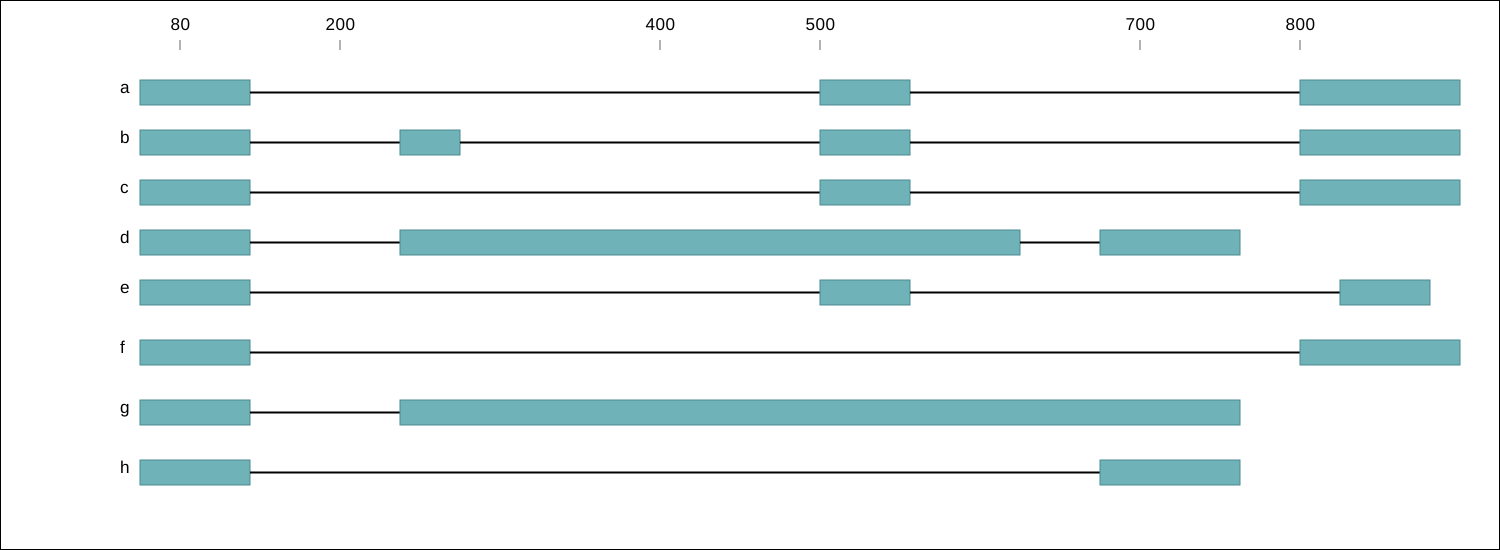
For a complex splicing example, please note the 2 alternative 3’ SS, 3
intron retention, and 4 exon skipping events in the following set of
isoforms that flair diffSplice would call and the isoforms that are
considered to include or exclude the each event:
a3ss_feature_id     coordinate                  sample1 sample2 ... isoform_ids
inclusion_chr1:80   chr1:80-400_chr1:80-450     75.0    35.0    ... a,e
exclusion_chr1:80   chr1:80-400_chr1:80-450     3.0     13.0    ... c
inclusion_chr1:500  chr1:500-650_chr1:500-700   4.0     18.0    ... d
exclusion_chr1:500  chr1:500-650_chr1:500-700   70.0    17.0    ... e
ir_feature_id           coordinate      sample1 sample2 ... isoform_ids
inclusion_chr1:500-650  chr1:500-650    46.0    13.0    ... g
exclusion_chr1:500-650  chr1:500-650    4.0     18.0    ... d
inclusion_chr1:500-700  chr1:500-700    46.0    13.0    ... g
exclusion_chr1:500-700  chr1:500-700    70.0    17.0    ... e
inclusion_chr1:250-450  chr1:250-450    50.0    31.0    ... d,g
exclusion_chr1:250-450  chr1:250-450    80.0    17.0    ... b
es_feature_id           coordinate      sample1 sample2 ... isoform_ids
inclusion_chr1:450-500  chr1:450-500    83.0    30.0    ... b,c
exclusion_chr1:450-500  chr1:450-500    56.0    15.0    ... f
inclusion_chr1:200-250  chr1:200-250    80.0    17.0    ... b
exclusion_chr1:200-250  chr1:200-250    3.0     13.0    ... c
inclusion_chr1:200-500  chr1:200-500    4.0     18.0    ... d
exclusion_chr1:200-500  chr1:200-500    22.0    15.0    ... h
inclusion_chr1:400-500  chr1:400-500    75.0    35.0    ... e,a
exclusion_chr1:400-500  chr1:400-500    56.0    15.0    ... f